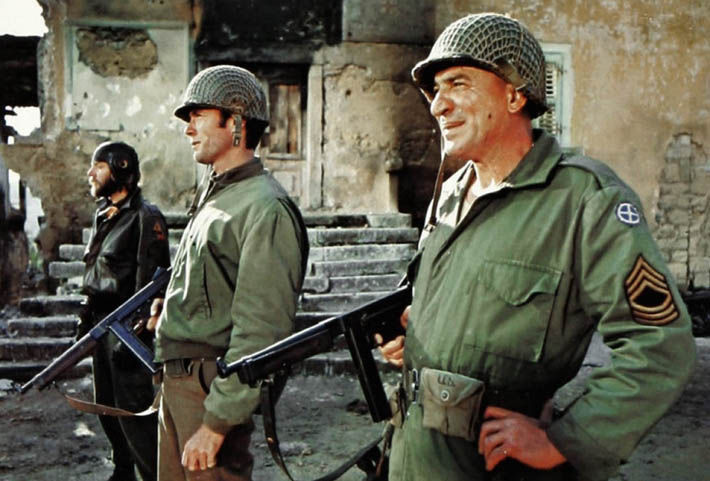
The Bridge at Remagen (1969)


A Gritty Look at the Final Days of the War
Released in 1969, The Bridge at Remagen is a tense Second World War drama directed by John Guillermin. Based on real events during the closing months of the war in Europe, the film tells the story of the unexpected capture of the Ludendorff Bridge, a crucial crossing over the Rhine River that helped accelerate the Allied advance into Nazi Germany.
Unlike many grand war epics of the era, The Bridge at Remagen takes a more grounded, soldier-level approach. Rather than focusing on sweeping strategy or heroic spectacle, the film concentrates on the chaos, uncertainty and moral complexity faced by the men fighting on both sides.
The Story
In March 1945, American forces advancing through western Germany make a startling discovery: the Ludendorff Bridge at Remagen is still standing. If the Allies can capture it before the Germans destroy it, they will gain a vital foothold across the Rhine — the last natural barrier protecting the German heartland.
The American advance is led by Lieutenant Phil Hartman, played by George Segal, whose unit is ordered to take the bridge before it can be demolished.
On the opposite side stands Major Paul Krüger, portrayed by Robert Vaughn, a weary German officer tasked with defending the crossing. Krüger understands the war is already lost, yet he is still bound by duty to carry out orders that will cost the lives of his remaining soldiers.
As American troops race across the bridge under relentless fire and repeated demolition attempts, the battle becomes a desperate struggle between time, explosives and human determination.
Performances
The strength of The Bridge at Remagen lies in its performances, particularly the film’s balanced portrayal of both American and German perspectives.
George Segal brings a relatable, almost reluctant leadership to Lieutenant Hartman. He is not portrayed as a traditional war hero but as a pragmatic officer trying to keep his men alive while fulfilling dangerous orders.
Robert Vaughn delivers one of the film’s most interesting performances as Major Krüger. His portrayal avoids caricature, presenting a German officer trapped between military duty and the growing realisation that the war is hopeless.
Ben Gazzara also stands out as Sergeant Angelo, whose tough, cynical personality reflects the exhaustion of soldiers who have been fighting across Europe for months.
Direction and Realism
Director John Guillermin emphasises realism over spectacle. The combat scenes are chaotic and grounded, capturing the confusion and fear of battle rather than glorifying it.
The film’s production itself became part of movie history. Much of the bridge battle was filmed in Czechoslovakia, but the Soviet invasion of the country in 1968 forced the production to relocate during filming. Despite these difficulties, the filmmakers managed to complete the film using a different bridge in Italy to replicate the Ludendorff crossing.
The result is a film that feels authentic and gritty, reflecting the changing tone of war movies in the late 1960s. Rather than celebrating triumph, the film highlights exhaustion, desperation and the human cost of conflict.
By showing both American and German perspectives, the film avoids simple good-versus-evil storytelling and instead presents war as a tragic struggle experienced by individuals caught in larger events.
Historical Context
The real capture of the Ludendorff Bridge on 7 March 1945 was a major turning point in the Allied advance into Germany. American troops managed to secure the bridge before it could be destroyed, allowing thousands of soldiers and vehicles to cross the Rhine.
Although the bridge eventually collapsed ten days later due to structural damage and German attacks, the Allied foothold across the river had already been established — significantly accelerating the end of the war in Europe.
The film dramatises these events while remaining broadly faithful to the historical significance of the battle.
Final Verdict
The Bridge at Remagen may not be as famous as other World War II films, but it remains a gripping and intelligent war drama. Its focus on character, moral ambiguity and the chaotic nature of combat sets it apart from more conventional war spectacles.
With strong performances, particularly from George Segal and Robert Vaughn, the film offers a compelling look at one of the final battles of the Second World War.