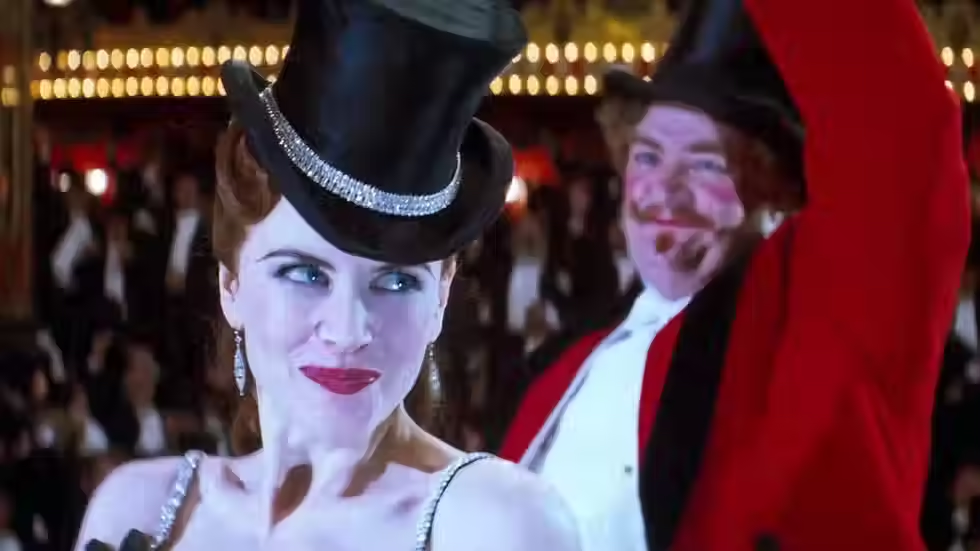
Eyes Wide Shut (1999)


Directed by the legendary Stanley Kubrick, Eyes Wide Shut was released in 1999, just months after the director’s death, and stands as one of the most enigmatic and provocative works of his career. Starring Tom Cruise and Nicole Kidman, the film is a haunting exploration of desire, jealousy, and the fragile boundaries between reality and fantasy. Adapted from Arthur Schnitzler’s 1926 novella Traumnovelle (Dream Story), Kubrick relocates the story from fin-de-siècle Vienna to modern-day New York, crafting a nocturnal odyssey that delves into the subconscious fears of intimacy and the shadowy recesses of the human psyche.
Dr. Bill Harford (Tom Cruise) and his wife Alice (Nicole Kidman) appear to have the perfect life — a comfortable Manhattan apartment, a loving marriage, and social success. Yet beneath this polished exterior lies an undercurrent of tension and curiosity. One night, after attending a lavish Christmas party hosted by Bill’s wealthy patient Victor Ziegler (Sydney Pollack), the couple engage in an intimate conversation that shatters the illusion of trust.
Alice confesses that, during a family holiday, she once fantasised about a naval officer she barely knew — an admission that leaves Bill shaken to his core. His masculine pride and sense of control are upended. In a fit of jealousy and existential confusion, he embarks on a surreal night-time journey through New York, encountering temptation, rejection, and danger at every turn.
His odyssey leads him to an underground society engaged in a ritualistic masked orgy — a secret world of sexual power and moral transgression. What follows is a descent into paranoia and moral reckoning as Bill grapples with guilt, secrecy, and the limits of his understanding. By the time dawn breaks, the experience has irreversibly altered his perception of both himself and his marriage.
Tom Cruise delivers one of the most restrained and introspective performances of his career. As Dr. Bill Harford, he perfectly embodies a man whose certainties — professional, sexual, and moral — are stripped away layer by layer. Cruise’s performance is all about control and repression; his smooth composure masks deep confusion and insecurity. Watching him wander through Kubrick’s eerie, hyper-real New York is like observing a man in a waking dream — detached, polite, but increasingly haunted.

Nicole Kidman, in one of her most complex early performances, is extraordinary as Alice. Her sensuality and intelligence dominate the film’s opening act, and her confession scene — in which she discloses her erotic fantasy — is mesmerising in its honesty and vulnerability. Kidman brings a quiet power to the role, suggesting that Alice’s inner life is richer and more mysterious than Bill’s rational world can comprehend.
Sydney Pollack is equally compelling as Ziegler, the urbane host whose genial façade conceals darker knowledge. His late-night confrontation with Bill is one of the film’s most ambiguous scenes, offering explanations that may or may not be true.
The supporting cast — including Marie Richardson as the bereaved daughter, Vinessa Shaw as a sex worker, and Leelee Sobieski as a mysterious young temptress — all contribute to the film’s dreamlike texture.
Kubrick’s direction is meticulous and hypnotic, with every frame laden with symbolic meaning. The film moves at a deliberate, almost trance-like pace, drawing the viewer into its unsettling rhythm. Working with cinematographer Larry Smith, Kubrick creates a visual world that is at once realistic and hallucinatory. New York is reimagined as a nocturnal labyrinth — streets glistening under artificial light, interiors glowing with sensual reds, blues, and golds.
The colour palette is crucial: red, symbolising both desire and danger, pervades the film, particularly in the orgy sequence and in the Harfords’ bedroom. Blue, by contrast, represents detachment and introspection — the emotional chill of modern existence. Kubrick shot the entire film on sound stages in England, and the artificiality of the sets adds to the uncanny atmosphere.
The camera movement is slow and deliberate, mirroring Bill’s disoriented mental state. Kubrick’s signature symmetrical compositions and deep-focus shots lend the film an air of unease; everything appears controlled, yet reality itself feels unstable.
At its core, Eyes Wide Shut is an examination of sexual repression, fidelity, and the illusions of modern marriage. Bill’s journey through the night is both literal and symbolic — a descent into the unconscious, where his insecurities and desires are laid bare. Kubrick portrays sexuality not as liberation, but as a battleground of power and vulnerability.
The film also explores class and privilege. Bill’s access to elite spaces — from Ziegler’s mansion to the masked orgy — reveals a society governed by secrecy and moral hypocrisy. The orgy sequence, far from being titillating, is clinical and ritualistic; it exposes the emptiness behind wealth and decadence.

Another key theme is the male ego and the illusion of control. Bill, who believes himself to be rational and moral, is confronted with forces he cannot master — women’s desire, hidden hierarchies, and his own subconscious. Alice, in contrast, achieves a kind of enlightenment through her dreams and honesty. In this sense, the film inverts traditional gender roles: the woman becomes the truth-teller, the man the seeker lost in illusion.
The dreamlike quality of Eyes Wide Shut has led many to interpret the entire film as a psychological dreamscape — perhaps even as a single extended dream from Bill’s perspective. Kubrick himself leaves such readings deliberately open-ended.
Jocelyn Pook’s haunting score contributes enormously to the film’s atmosphere. Her use of choral fragments, reversed chanting, and minimalist piano motifs creates an otherworldly tension that lingers long after viewing. The recurring piano note motif — slow, deliberate, and dissonant — becomes an auditory symbol of Bill’s guilt and anxiety.
The famous orgy sequence is underscored by Pook’s composition Masked Ball, a piece built on reversed Romanian liturgy, giving the scene an eerie sense of sacrilege. Classical works by Shostakovich and Ligeti add to the sense of high-art surrealism, contrasting the film’s sensuality with cold formality.
Eyes Wide Shut was Kubrick’s final film, completed just days before his death in March 1999. Its release was surrounded by intrigue, not least because of its explicit sexual content and the myth that Kubrick had planned further edits. Regardless, the film feels like a fitting conclusion to his body of work — a summation of themes he had explored for decades: alienation (2001: A Space Odyssey), moral decay (A Clockwork Orange), the fragility of civilisation (Barry Lyndon), and the impossibility of truly understanding another person (The Shining).
Kubrick’s meticulous approach to human psychology reaches its apex here. Every gesture, every object — a mask, a key, a dream — is laden with symbolic resonance. The film invites endless analysis, resisting definitive interpretation.
Upon its release, Eyes Wide Shut divided critics and audiences. Some dismissed it as cold, overlong, or self-indulgent; others hailed it as a masterpiece of modern cinema. Over time, however, its reputation has grown substantially. What initially seemed puzzling or slow has revealed itself as deliberate and profound — a meditation on human frailty in a world of artifice.
The film’s eroticism, often misunderstood, is not about titillation but about psychological exposure. It influenced numerous later works exploring the darker corners of desire, from Mulholland Drive to The Dreamers.
Today, Eyes Wide Shut is widely recognised as one of Kubrick’s most personal and haunting films. Its slow burn, meticulous detail, and enigmatic symbolism reward repeated viewings. Like a dream that changes shape upon recollection, the film remains elusive, refusing to be neatly explained.
Eyes Wide Shut is an extraordinary work of art — a hypnotic, unsettling, and deeply human exploration of love, desire, and the masks we wear. Kubrick transforms what could have been a mere erotic thriller into a philosophical study of fidelity, identity, and moral awakening. With mesmerising performances from Cruise and Kidman, stunning visual design, and an atmosphere of dreamlike menace, it stands as one of the defining films of the 1990s.
Challenging, ambiguous, and endlessly fascinating, Eyes Wide Shut is not a film to be “solved”, but to be experienced — like a dream from which one awakens changed.